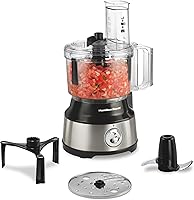
How to Use a Black and Decker Food Processor
To use a Black and Decker food processor, seat the bowl on the base, fit the blade, and lock the lid before you press the control. Add food in pieces no larger than the bowl and pulse in short bursts so you can watch the texture.
On this page (8 sections)
- How do you set up a Black and Decker food processor?
- How do you use the controls on a Black and Decker chopper?
- How do you chop vegetables and herbs in a food processor?
- How do you use a food processor for dips and dressings?
- Can you use a Black and Decker food processor to make dough?
- How do you use a food processor as a blender?
- How do you clean and store the chopper safely?
- Which Black and Decker chopper fits your kitchen?
To use a Black and Decker food processor, seat the bowl on the base, fit the blade, and lock the lid before you press the control. Load food in pieces no larger than the bowl and pulse in short bursts so you can watch the texture.
The steps below cover setup, chopping, liquids, dough and cleanup for the compact chopper most people picture when they look up how to use a Black and Decker food processor.
The compact models in this line are choppers rather than full-size processors. The HC300B has one bowl, one blade and one button, with a 175W motor and a 3-cup bowl.
Once you know that, the machine is quick to run.
How do you set up a Black and Decker food processor?
Place the base on a flat, dry counter, set the bowl on it, add the blade, then lock the lid. Each part only seats one way, so a lid that won't press down usually means the bowl isn't sitting straight.
Start with the motor base unplugged while you assemble. The HC300B base measures 5 inches deep, 6.5 inches wide and 7 inches tall, so it fits under most upper cabinets and leaves room to lift the lid.
The whole unit weighs 1.8 pounds, light enough to move to a pantry shelf when the counter is crowded.
What goes on first, the bowl or the blade?
The bowl goes on the base first. The HC300B uses an improved chopping assembly and lid, and the bowl presses onto the base before the blade drops onto the center post.
Lower the stainless steel blade onto the post with the edge facing down. It's a bi-level blade, so the two sets of edges sit at different heights and reach food near the bottom and the top of the bowl.
The blade is stainless steel, and BLACK+DECKER calls it stay-sharp.
How do you lock the lid?
Set the lid flat on the bowl and press it down until it seats. The safety interlock keeps the motor off unless the lid is locked, so the machine won't spin with the lid loose.
The HC300B lid also has small oil holes. Keep them closed when you aren't drizzling, and check the lid seal is clear of crumbs before you press it down.
The lid and chopping assembly are the improved parts on this model, so a firm press is what seats them.
How do you use the controls on a Black and Decker chopper?
Press the one-touch pulse button and hold it for short bursts. The HC300B has one speed, so pulse length is your only control over how fine the food gets.
A 2-second press gives a rough chop. Holding for 5 to 8 seconds takes herbs and nuts much finer.
Release and look at the bowl between bursts rather than running one long press.
Give the bowl a shake or scrape down the sides if food climbs the walls. Avoid pressing the button with the lid off or the bowl empty, and unplug the base before you take the blade out.
The HC300B runs at a single speed, so there is no high or low setting to choose between.
How do you chop vegetables and herbs in a food processor?
Cut food into even, thumb-sized pieces and pulse in batches so the blade bites every piece. Uneven sizes are the main reason a chopper leaves big chunks beside mush.
Fill the bowl about two-thirds full. With a 3-cup bowl, that's roughly 2 cups of onion or carrot per round.
For salsa, pulse onion first, then add tomato and pulse briefly so it stays chunky. BLACK+DECKER lists chopping as this model's use, so vegetables and herbs are its intended work.
Which foods are hard on a 3-cup chopper?
The HC300B is built for chopping, and its 175W motor suits onion, garlic, herbs, nuts, breadcrumbs and cooked vegetables. Fibrous or very hard items like whole ginger and large meat cuts ask more of a small chopper.
The bowl holds 3 cups and the motor is 175W, so the machine does best when the pieces are small and the batch is light.
Chop raw meat only in small pieces if you do it at all, and wash the single blade thoroughly after it touches raw meat before you use it on vegetables. That's a cleanliness habit, not a machine limit.
How do you get an even chop?
Use short pulses and stop early. The blade stops when you release the button, so check the texture as you scrape down the bowl and pulse again only if it needs it.
For breadcrumbs, tear bread into pieces and pulse 4 to 5 times. A few larger crumbs are better than powder, and stale bread chops more cleanly than fresh.
Breadcrumbs are one of the jobs BLACK+DECKER names for this chopper, along with dips and salsa.
How do you use a food processor for dips and dressings?
Add the solid ingredients first, pulse to a paste, then drizzle oil through the lid holes while the blade turns. The HC300B is built for this, and its oil holes let you add oil to hummus and vinaigrette as you mix without making a mess.
For hummus, pulse chickpeas, garlic and lemon to a rough paste, then stream in olive oil and a spoon of water. For vinaigrette, pulse mustard and vinegar, then drizzle oil slowly until the dressing thickens.
Dips and vinaigrettes are two of the uses BLACK+DECKER lists for this model.
Stop before the mixture looks smooth if you like texture. Dips thicken as they stand, so a loose hummus firms up in the fridge within half an hour.
Can you use a Black and Decker food processor to make dough?
Only in small amounts and with care. The HC300B is sold as a chopper with one speed and a 3-cup bowl, so it suits a small batch of pastry or a quick pizza dough far better than a full loaf.
Keep the dough to about 1 cup of flour so the motor isn't working against a heavy mass. Pulse in short bursts and stop as soon as the dough pulls together.
If you plan to bake bread often, read our guide to whether you can use a food processor to make dough before you rely on a compact chopper.
How do you use a food processor as a blender?
A chopper can make a rough puree, but it won't blend thin liquids like a blender. The HC300B bowl is wide and short, so liquid splashes the lid rather than forming a vortex.
Use it for thick mixtures such as pesto, sauce bases and soup paste. For smoothies or thin soups, a blender is the right tool.
Our explainer on whether you can use a food processor as a blender covers where the two overlap.
How do you clean and store the chopper safely?
Unplug the base first, then wash the bowl, lid and blade. The removable parts on the HC300B are dishwasher-safe, which makes cleanup the easiest step of the whole job.
Take the blade off by its plastic hub, not the edge. Wash it by hand if you'd rather keep the edge sharp, and let it dry fully before storage.
The HC300B is dishwasher safe, so the removable parts can go straight in the rack.
How do you wash the base?
Wipe the motor base with a damp cloth and dry it straight away. Never put the base in water or the dishwasher, and keep the cord and plug away from the sink.
The base is plastic and holds the 110 volt motor, so it stays out of the water while the bowl and blade soak or rinse.
How do you store the blade?
Keep the blade in its own container or a drawer guard. Don't leave it loose in a drawer where hands can reach in and find the edge.
Which Black and Decker chopper fits your kitchen?
The HC300B suits small kitchens and everyday jobs: dips, salsa, breadcrumbs and herb chopping for one or two people. It's a 3-cup chopper with a 175W motor, a one-touch pulse and dishwasher-safe parts.
The unit ships as a single item, model HC300B, so there are no extra discs or bowls to store.
If you cook for a crowd or want slicing and shredding discs, a full-size processor is the better buy. If you only need small batches and easy cleanup, this one covers it.
Compare what you can use instead of a food processor if you're weighing a knife and board against another appliance.
For another compact chopper, our guide on how to use a Hamilton Beach food processor covers the same setup steps for that brand. For the Black and Decker, the routine stays the same: seat the bowl and blade, pulse in short bursts, and wash the parts when you're done.
Frequently asked questions
How do I turn on a Black and Decker food processor?
Seat the lid on the bowl and press it down until it locks, then press the one-touch pulse button on top. The motor runs only while you hold the button, so release it to stop and check the texture before pulsing again.
Can I put the bowl and blade in the dishwasher?
Yes. The removable bowl, lid and stainless steel blade on the HC300B are dishwasher-safe.
Wipe the base with a damp cloth and keep the motor unit away from water before you put the parts back together.
Why won't my Black and Decker food processor start?
The lid is probably not seated all the way down. The safety interlock keeps the motor off unless the lid is locked, so press it down firmly and check the base is on a flat, dry surface.
How much food should I put in a 3-cup food processor?
Fill the bowl no more than about two-thirds full so the blade can move freely. That works out to roughly 2 cups of chopped vegetables or herbs, and you run big batches in two rounds instead of one packed bowl.
Can I add oil while the chopper is running?
The HC300B lid has small oil holes so you can pour oil in as the blade turns. That suits hummus and vinaigrette, where a steady drizzle emulsifies better than adding all the oil at once before you pulse.