Can You Make Cakes in a Food Processor?
Yes, you can make most cake recipes in a food processor. The machine creams butter and sugar, mixes wet and dry ingredients and chops nuts or chocolate in seconds, though it can overwork batter if you leave it running.
On this page (9 sections)
- Can you make cakes in a food processor?
- Which cake steps suit a food processor?
- How do you mix cake batter without overworking it?
- What cakes should you not make in a food processor?
- How do you cream butter and sugar in a food processor?
- Can a food processor handle large batches of cake batter?
- Which food processors suit cake making?
- What should you know before baking a cake this way?
- Which method should you choose?
Yes, you can make cakes in a food processor. The machine creams butter and sugar, mixes wet ingredients and chops add-ins quickly, so most butter cakes and loaf cakes come out fine.
Delicate sponge cakes are the exception, because they need air and gentle folding rather than a fast spinning blade.
That short answer covers the main decision. The rest depends on which cake you are baking and which steps you hand to the machine.
Can you make cakes in a food processor?
You can make most everyday cakes in a food processor, including pound cake, carrot cake, banana bread and brownies. These batters are dense enough to take the blade's action without collapsing.
The processor earns its place on the prep work. It creams butter and sugar, mixes eggs and milk into the butter, and chops nuts or chocolate for folding in later.
One bowl handles a job that would otherwise use two or three.
Where it struggles is anything that depends on trapped air. A light sponge or angel food cake needs whipped egg whites and slow folding.
A food processor beats air out of the batter and develops gluten fast, so those cakes turn dense and chewy.
So the honest answer is yes with conditions. Use the processor for butter-based cakes and quick breads, and keep the whisk or stand mixer for recipes built on air.
Which cake steps suit a food processor?
Creaming, wet mixing and chopping are the three steps a food processor handles well. Each one takes seconds and saves a bowl.
Creaming butter and sugar is the first win. Cut softened butter into cubes, add the sugar and run the machine until the mix turns pale.
Scrape the bowl once so nothing sticks near the top edge.
Mixing wet ingredients is the second. Add eggs one at a time through the feed chute, then the milk or buttermilk.
The blade combines them evenly without splashing.
Chopping is the third. Nuts, chocolate, dried fruit and cookie pieces all break down in short pulses.
Stop before they turn to paste and stir them into the batter by hand.
Folding in flour is where the processor needs care. Add the flour last and pulse in short bursts just until it disappears.
A few streaks left in the batter are better than a smooth, overworked mix.
How do you mix cake batter without overworking it?
Use short pulses and stop as soon as the flour is combined. The goal is a batter that is mixed, not whipped.
Add the flour in two or three additions, pulsing between each. Each pulse should last about one second.
Open the lid and scrape down the sides so the flour at the top edge gets worked in.
Watch the batter's look rather than the clock. It should be smooth with no dry patches, and still soft.
If it starts to look glossy and stretchy, you have gone too far.
For a cake with add-ins, fold the chopped nuts or chocolate in by hand after the flour. The blade would grind them into the batter and toughen the crumb.
What cakes should you not make in a food processor?
Skip the processor for sponge, angel food and chiffon cakes, plus any recipe that depends on whipped egg whites for lift. The blade cannot whip air into egg whites the way a whisk does.
These cakes get their height from a foam of tiny air bubbles. A processor's fast blade breaks those bubbles down instead of building them.
The result is a flat, rubbery cake.
Very thin crepe batters and light genoise also sit better in a mixer or by hand. Use the processor for the parts that suit it and switch tools for the rest.
Chopping the nuts in the processor and folding the whipped whites by hand is a sensible split. That way the machine saves time without spoiling the bake.
How do you cream butter and sugar in a food processor?
Cut softened butter into cubes, add the sugar and process until pale and fluffy. This usually takes 30 to 60 seconds, with one scrape down halfway.
The butter needs to be soft but not melted. Take it out of the fridge about 30 minutes ahead, or cut it into cubes and let it sit at room temperature.
Cold butter stays in lumps and won't cream evenly.
Use the chopping blade for this step. Run the machine in short bursts rather than one long spin.
The bursts keep the butter from heating up against the bowl.
If the bowl feels warm or the butter starts to look greasy, stop and rest the machine for a few minutes. Warm butter cannot hold the air that makes a cake rise.
A cool bowl gives the best results.
Scrape the mixture down once or twice so the sugar near the top edge gets worked in. When the mix looks lighter in color and holds soft peaks against the blade, it is ready for the eggs.
Can a food processor handle large batches of cake batter?
Bowl size sets the limit on how much batter you can mix at once. A 7-cup bowl suits one standard 8-inch layer cake or one loaf.
A 9-cup or 14-cup bowl handles larger batches and double recipes.
Overfilling is the common mistake. A batter that reaches the top of the bowl spills when the blade starts, and the machine labors.
Fill no more than about two-thirds of the bowl.
If your recipe makes two thick layers and your bowl is small, mix the batter in two batches. Split the ingredients evenly so both batches bake the same.
Or mix the wet ingredients in the processor and finish with a large bowl and a spoon.
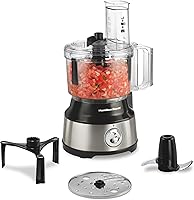
For bigger batches, the extra capacity helps. A 14-cup model like the Hamilton Beach Stack & Snap covers large layer cakes and sheet cakes without a second round.
Its mini bowl also chops nuts and chocolate for add-ins in small amounts.
Which food processors suit cake making?
A processor with a dough blade and a large bowl covers the most cake jobs. The dough blade is gentler on batter than the chopping blade, so it is worth using for the final mix.
Here are three models that fit the task. Our scores weigh specs and features against what a home baker shopping for a processor needs.
The Ninja PrecisionPro BZ601 earns our top score for cake making. Its 9-cup bowl handles a double layer cake or two loaves at once.
The 1000-peak-watt motor and dough blade mix thick batters without straining. The reversible slicing and shredding disc also preps carrots for carrot cake or apple for an apple cake.
Four Auto-iQ presets take the guesswork out of chopping and mixing, and the parts are dishwasher safe.
The Cuisinart 7-Cup Pro Classic is the pick for smaller kitchens and one-layer bakes. Its 7-cup bowl suits a single 8-inch cake or a loaf.
The 600-watt motor runs quietly, and the included chopping, mixing and dough blade handles batter from creaming to the final pulse. The feed tube takes whole fruits and vegetables, so you can grate and slice without a separate tool.
It has a simpler on/off and pulse control than the Ninja.
The Hamilton Beach Stack & Snap 14-Cup is the choice when you bake in volume. The 14-cup bowl mixes a large sheet cake or a double batch of muffins, and the 4-cup mini bowl chops nuts or chocolate for topping.
The dough blade kneads and mixes, and the 500-watt motor with two pulse speeds handles thick batters. The stack and snap assembly means no twisting to lock the bowl in place.
Pick the Ninja for most home bakers, the Cuisinart for small kitchens and simple controls, and the Hamilton Beach for big batches. If you also bake bread, our guide to using a food processor to make dough covers the dough blade in more detail.
What should you know before baking a cake this way?
Use the processor for prep and mixing, then finish by hand when the recipe needs air. That rule keeps light cakes light and dense cakes easy.
Weigh or measure ingredients before you start. A food processor runs fast, so having everything ready means less stopping and starting.
Soften the butter ahead and let eggs come to room temperature.
Follow the recipe's mixing order. Creaming first, then eggs, then dry ingredients is the standard path.
Reversing it gives a lumpy batter that takes longer to smooth out.
If you don't own a processor yet and want to know what else can stand in, see what you can use instead of a food processor. And if you want to blend a frosting or a fruit puree for a cake filling, our piece on using a food processor as a blender explains the limits.
Which method should you choose?
Use the food processor when speed matters and the cake is butter-based. Cream the butter and sugar in the bowl, add the eggs and milk, then pulse in the flour until just combined.
Fold in nuts or chocolate by hand.
Use a whisk or stand mixer for sponge, angel food and chiffon cakes. These need air and gentle folding, and the processor cannot give them that.
So the final rule is simple. Can you make cakes in a food processor?
Yes, for most everyday recipes. Pick the Ninja PrecisionPro BZ601 for a versatile 9-cup machine that also chops and shreds.
Choose the Cuisinart 7-Cup for smaller batches, or the Hamilton Beach Stack & Snap for large ones. Then keep the whisk nearby for the light, airy bakes that a processor cannot handle.
Frequently asked questions
Can you mix cake batter in a food processor?
You can mix cake batter in a food processor using short pulses. Add the flour last and pulse only until it disappears into the batter.
Running the blade continuously develops gluten and knocks out air, which gives you a dense, chewy cake.
How do you cream butter and sugar in a food processor?
Cut softened butter into cubes, add the sugar and run the processor until the mix turns pale and fluffy. Scrape the bowl down once or twice.
Stop and rest the machine if the bowl feels warm, so the butter does not melt before the flour goes in.
Can you chop nuts and chocolate for cake in a food processor?
Yes. Pulse nuts, chocolate, dried fruit or cookie pieces in short bursts until they reach the size you want.
Stop before they turn to paste.
Add them to the batter by hand at the end so the blade does not grind them further.